The Judas Kiss
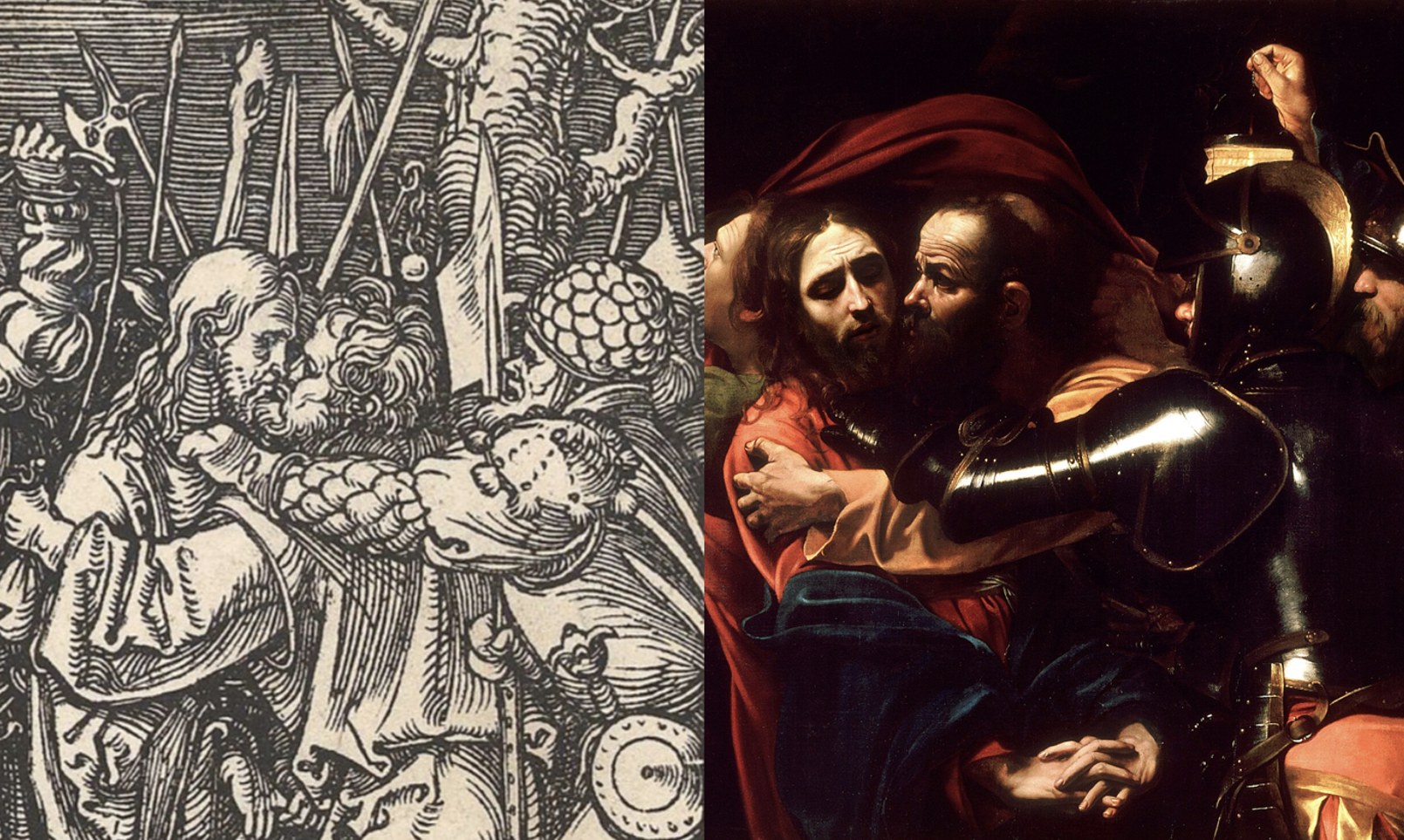
Details from ‘The Betrayal of Christ’, Albrecht Dürer, ca 1509, and ‘The Taking of Christ’, Caravaggio, ca 1603.
The Gospel descriptions of the betrayal of Jesus in the Garden of Gethsemane leave space for us, as they have to many others over the centuries, to fill in the details of that moment of ‘the Judas kiss’.
There was nothing inherently wrong or unusual in greeting a friend with a kiss: St Paul commended it more than once in his letters. It had long been appreciated, however, that a kiss could also be a prelude to betrayal: in the Book of Proverbs, it is written that ‘the kisses of an enemy are deceitful’.
The Judas kiss is central to ‘The Taking of Christ’ by the Italian artist Caravaggio. In 1603 or thereabouts, Ciriaco Mattei, elder brother of Cardinal Girolamo Mattei, commissioned and bought the painting. According to what I have read, it remained in Palazzo Mattei in Rome for two centuries before ‘disappearing into the obscurity of a private Scottish collection’. It reappeared in the possession of the Irish Jesuit Fathers in the 1990s and was given on loan to the Irish National Gallery.
Caravaggio’s painting seems to borrow and develop ideas from Dürer’s woodcut of a century earlier: Judas’ is roughly grasping Jesus, the soldier in armour is reaching out to seize Jesus’ neck. But what an astonishing development of the facial expressions Caravaggio has made. Jesus’ face seems to show sorrowful acceptance of the kiss and the betrayal, while in Judas’ grimace there is a mixture of brutality and uncertainty. Here there is a meeting of good and evil, innocence and corruption.
With these facial expressions, Caravaggio seems to have anticipated current opinion that the greater part of human communication is non-verbal.
It is a dark moment, although I recently read an alternative and less harrowing imagining of this scene in the book The Faces of Jesus by the American Presbyterian minister and author Frederick Buechner (1926-2022). At the moment of the treacherous kiss, Frederick Buechner had a mental picture of Jesus’ arm raised in benediction. He was forgiving Judas for what he had just done, and also forgiving all those others down through the centuries who have felt the pain of remorse on realising that in some way or other, in thought, in word, or in deed, they have betrayed the Son of God.
Reference: Caravaggio. A Life Sacred and Profane, Andrew Graham-Dixon, Penguin London 2010